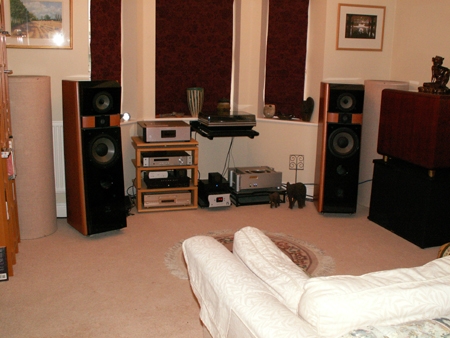

A room is filled with sound–pressurized, rippling waves pushing through a room and filling it the way a pulsing ocean does a cove. Loudspeakers generate this pressure using two types of sound: treble and bass. Treble waves are small and directional compared to the larger, more powerful, and omnidirectional bass waves. Full-range audio is the mixture of these two sounds.
Unfortunately, strong bass can flood a room and overwhelm the relatively weak treble, disrupting the delicate balance created by the loudspeaker engineer.
Below, we show step by step, graphically, the source and propagation of both the “bad sound” and the “good sound”. Then you’ll see where TubeTraps are indispensible.
While this story applies specifically to dynamic box speakers, the same holds true with dipoles and omnis – just in somewhat different directions. And to all you horn-lovers: meaningful directivity of a sub bass horn requires a mouth the size of a garage. Sorry, physics can be mean.

1. A loudspeaker has a tweeter and/or mid driver that makes sound in the treble range. It also has a large woofer that makes sound in the musical bass range.

2. The treble range of a loudspeaker is projected clearly in the forward direction, but is not projected to the rear of the speaker.

3. The bass range is projected clearly in all directions with equal strength. The bass is just as loud and clear in front, behind, and to the sides of the speaker.

4. When full-range music is played through a loudspeaker, both the bass and treble ranges are made by the speaker. The good sounding blend of bass plus treble, full-range music, is heard in front of the speaker. The not-very-good-sounding bass only sound is projected behind the speaker.

5. In HiFi, speakers are set up facing in the direction of where the listener is seated. Good, well balanced bass and treble sound is projected toward the listener. The bad, not balanced, bass heavy sound is projected away from the listener.

6. HiFi is set up in room with speakers near one end of the room and the listener near the other end of the room. Speakers project good quality sound towards the listening end of the room and project bad quality, bass heavy sound towards the opposite end of the room, away from the listener.

7. The bad quality bass heavy sound bounces off the front wall and floods into the good sounding part of the listening room. The bad quality sound mixes with the good quality sound to make a medium quality sound in the listening part of the room.

8. TubeTraps absorb bass and reflect, scatter, and diffuse treble. Place the traps to the side of and behind the speakers and they absorb bad quality sound before it can reflect off the walls to the side and behind the speaker and flood into the good quality side of the room.

9. TubeTraps absorb unwanted bass energy and scatter the desirable treble range sound. TubeTraps along the front wall have reflectors facing into the room. TubeTraps on side wall have reflectors facing the front wall. All TubeTraps have a chrome metal button marking the center of the reflector inside the TubeTrap.