

Art’s Presented Papers
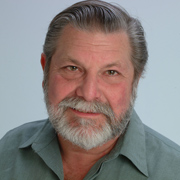 Art Noxon is a fully accredited Professional Acoustical Engineer with Master’s degree in both Mechanical Engineering (Acoustics) and Physics. He invented the TubeTrap in 1983. He created Acoustic Sciences Corp in 1984 to manufacture and distribute the TubeTrap. A prolific inventor, he has 12 TubeTrap related patents and has developed over 150 other acoustic devices and counting. A scientist, lecturer, writer, and teacher of acoustics, Art Noxon has presented numerous AES papers, magazine articles, white papers, lectures and classes in the field of applied acoustics.
A Career in Sound
A lecture/demo given by Art Noxon PE Acoustic from 2018 to high school girls who might be interested in a career in sound Hosted by WISE; Women in Science and Engineering and STEM; Science, Technology, Engineering and Mathematics View as PDF

Art Noxon at AES 2015
W3 – Low Frequency Behavior in Small High Accuracy Listening Environments Listen to Art’s talk: October 29, 2:15 pm – 4:15 pm (Room 1A22) Chair: John Storyk, Architect, Studio Designer and Principal, Walters-Storyk Design Group – Highland, NY, USA

How TubeTraps Opened a New Realm in Audio Playback
It’s been asked: How have TubeTraps Open a New Realm of Precision in the Performance of Audio Playback Systems? Well, audio minded people know to place TubeTraps in the corners behind the speakers and they know what benefits are delivered.

The Sound of Space Design
An invited lecture to Interior Design class at Oregon State College in 2012 | View as PDF The goal of this paper is to help interior designers open their eyes to the sound of the space they are designing. We can’t see sound but we can begin to hear it. Normally sound is taken as a given, something that just is, has been and always just be there. True but, sound has qualities which can be adjusted to better suit the designated use of the space being designed.

ASC’s 5.1 Surround AttackWall
Transcript of a seminar presented by Arthur Noxon P.E., President of Acoustic Sciences Corporation, at the Surround 2001 International Conference and Technology Showcase December 7-8, 2001, Beverly Hills, CA. View as PDF The traditional recording studio has its acoustic package either built into or mounted directly on the surfaces of the room, the walls, ceiling, floor and corners.

The Chain Is As Strong As Its Weakest Link
An article by Art Noxon written for the first Hong Kong HiFi Show, 1993 – Translated and published in Chinese The electronic components and interconnects available in today’s hi end audio are superb. Yet there is always room for improvement and changes in both the technology and style of audio as the chain is as strong as its weakest link.

Correlation Detection of Early Reflections (AES-1992)
Arthur M. Noxon Acoustic Sciences Corporation | Eugene, Oregon USA Correlation Detection of Early Reflections (AES-1992) Presented at the 11th AES International Conference: Test and Measurement Portland, Oregon, May 1992 View as PDF ABSRACT Correlation Detection of Early Reflections (AES-1992). Coherent and incoherent reflections are very different, both in physical and psychoacoustic properties.

The Wall In The Desert
An old saying is known in many countries “The chain is only as strong as its weakest link.” Often, when we talk about the parts in our audio system, they are referred to as components and interconnects in the audio chain. Each component processes the signal and the interconnects transfer the signal from one component to another.

Room Acoustics for Eurovision (AES-1991)
This AES paper presented by I Stamac & S Ctamac with consultation from Art Noxon started off as a unique project to use TubeTraps to convert a classical concert hall into a TV studio for the European version of a “Miss America” contest to be broadcast live: Room Acoustics for Eurovision (AES-1991). It ended with DIY TubeTraps being made, with our help, and the show was a success.

Sound Fusion and the Acoustic Presence Effect (AES-1990)
Presented by Art Noxon at the 89th AES Convention, Los Angeles, Sept. 1990 View as PDF Abstract In the perception of sound, early reflections are correlated with the direct signal by the listener. Comb coloration effects arise when there are too few specular, coherent reflections.

Articulation – Prerequisite to Performance (AES-1989)
Acoustic Sciences Corporation Eugene, Oregon USA Articulation – Prerequisite to Performance (AES-1989) Presented by Art Noxon at the 87th AES Convention New York, October 1989 PDF Version The Modulation Transfer Function is the established basis for testing the quality of speech intelligibility. This paper reviews the current of MTF test signals as the performance spec for HiFi and pro sound playback rooms.

Articulation and the Small Room (AES-1988)
Presented by Arthur Noxon of Acoustic Sciences Corporation. Eugene, OR., at the 85th AES Convention, Los Angeles, CA, November 6, 1988 View as PDF Introduction: Let’s talk Articulation and the Small Room
Controlled Reflection Isolation Booth (AES-1987)
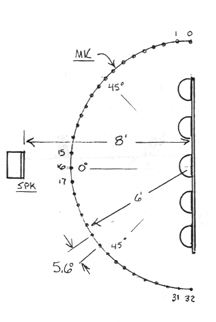
Presented by Art Noxon at the 83rd AES Convention, (New York October 16-19, 1987) this paper discusses how TubeTraps led recording engineers to discover that lots of very early reflections produce a better, more manageable sound than the traditional, reflection-free, dry studio recording. This paper introduces the concept of a sampling room, highly reflective with a fast RT60. Preprint No. 2531 View as PDF

Room Acoustics and Low Frequency Damping (AES-1986)
Presented by Art Noxon at the 81st AES Convention, (November 13-16, 1986) this paper takes a look at how room modes are managed by corner bass traps. View as PDF Introduction (Not presented but provided for clarity) The Sabine type formulas of decay rates are derived for diffuse sound fields. This restricts their use typically to 300 Hz and above.
Listening Room – Corner Loaded Bass Trap (AES-1985)
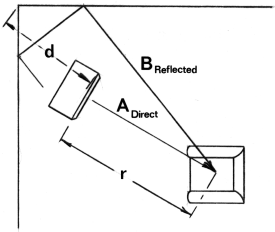
Presented by Art Noxon at the 79th AES Convention, (New York October 12-16, 1985) this paper discusses the physics behind how corner loaded bass traps work. It was written decades ago, just as the ASC TubeTrap had recently been introduced for use in HiFi audio.
Masters Thesis: Ripple Tank and Acoustic Analogue
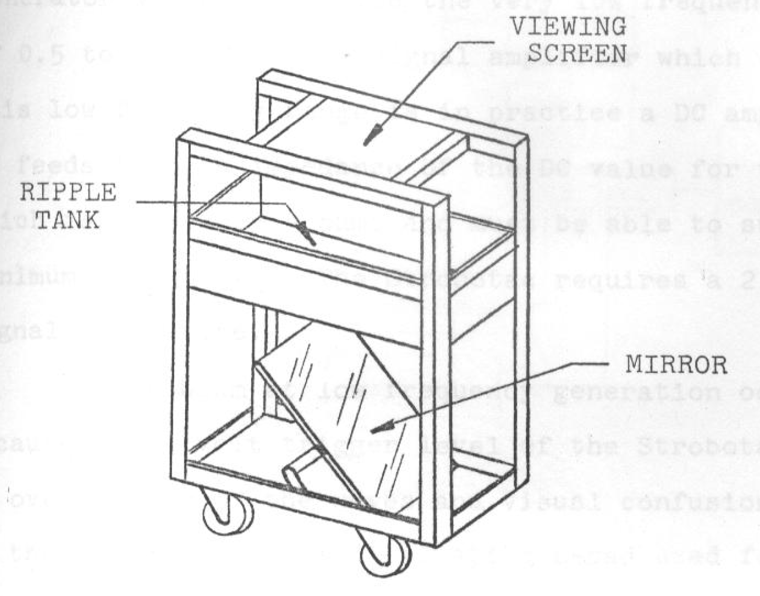
The Masters Thesis: Ripple Tank and Acoustic Analogue. The Ripple Tank is a classic method to visualize wave propagation. This book is the written thesis which accompanied the physical ripple tank system I developed for the master’s degree in mechanical engineering at Cal State University at Long Beach in 1975.

