
Articulation: Prerequisite to Performance pt.1
From AES 1989 comes a definitive paper by Art Noxon, TubeTrap inventor and ASC founder and President, that explains the use of the Modulation Transfer Function to measure intelligibility of a sound reproduction system. This week the topic is introduced and you will see how a series of tone bursts is in fact the most appropriate signal for gauging the articulation of your room and audio system..
ARTICULATION: Prerequisite to Performance
by Arthur M. NoxonRead the entire paper
The Modulation Transfer Function is the established basis for testing the quality of speech intelligibility. This paper reviews the current of MTF test signals as the performance spec for hi-fi and pro sound playback rooms. Recordings of the test, made in a listening room under different conditions of acoustic treatment, will be played while hard copy is displayed.
Acoustic Articulation is the ability of an acoustic space to faithfully track signal level changes. That description alone is sufficient to warrant our attention to the subject. What would the world be like if we increased audio signal gain, but did not hear a corresponding sound level rise? What if we cut the signal power and did not experience a drop in sound level? Articulation is such a fundamental concept that it is easily taken for granted. It is the current best indicator for a communication channel and human perception. That is why we use articulation measurements as the baseline for evaluating sound systems.
Introduction
The search to define quality audio playback has for many years been keyed to electronic performance specifications. However, the final link in an audio chain is always the acoustic coupler, the interconnect between the speaker and the listener. The proverbial chain is still only as strong as its weakest link and with today’s sophisticated electronics and transducers, the weakest link in the audio chain is undoubtedly the playback room. The question inevitably arises as to how to test the room as the final link in the audio chain and what should be the specification.
The long-standing test procedure for room acoustics is the RT-60 decay time measurement. In the last few years, a new acoustic test has been introduced into audio. It is the speech intelligibility test and it comes from the world of speech and communication. Intelligibility measurements combine the consequences of RT-60 with the room’s background noise level to predict the integrity that remains of a modulated signal that has been transmitted across a room. This test is applied to the acoustic link of sound systems that are as huge as a dome stadium to as small as a telephone earpiece. Intelligibility testing is now beginning to impact pro sound and hi end audio, that is why it is the topic of this paper.
Over the last few years B & K (RASTI) and the Crown (Tecron) each have produced a procedure to measure speech intelligibility. Their data is converted into a single number, the STI (Speech Transmission Index). This test equipment only monitors the performance of an existing system and is not a piece of diagnostic equipment. The STI is a performance rating number, it does not help the engineer to know what to fix in order to get a better STI. The next generation of test equipment in this arena will naturally be of the diagnostic type.
The concern for intelligibility and how to measure it is not new. It dates back at least to early radio days with the problem of signal-to-noise ratio (SNR) that prevents messages from getting through. The development of the telegraph, telephone and radio, right on into today’s deep space communications form a continuous chain of contributions to the advancement in the understanding of the perception of signals.
Speech Intelligibility
Within the last few years, Speech Intelligibility has surfaced as a performance requirement in sound systems. Engineers, designers, contractors and architects no longer only work towards smooth-sound level distributions and properly shaped octave band equalization (EQ) contours; now they are being required to meet STI criteria. Speech intelligibility is a special application of the basic concept of articulation. It is a speech band limited and “weighted” version of articulation.
We encounter something similar when doing sound level measurements. The “A-Weighted” sound level frequency response curve is not a “flat” response curve, it has been modified to include the loss of efficiency of human perception in the lower and very high frequency range. It is the weighted response curve that is integrated over the audio range to achieve the total adjusted sound level in dB, A. This is directly analogous to the STI which is an integration of the articulation frequency response curve which has been weighted for the purpose of speech and communication.
Modulation Transfer Function
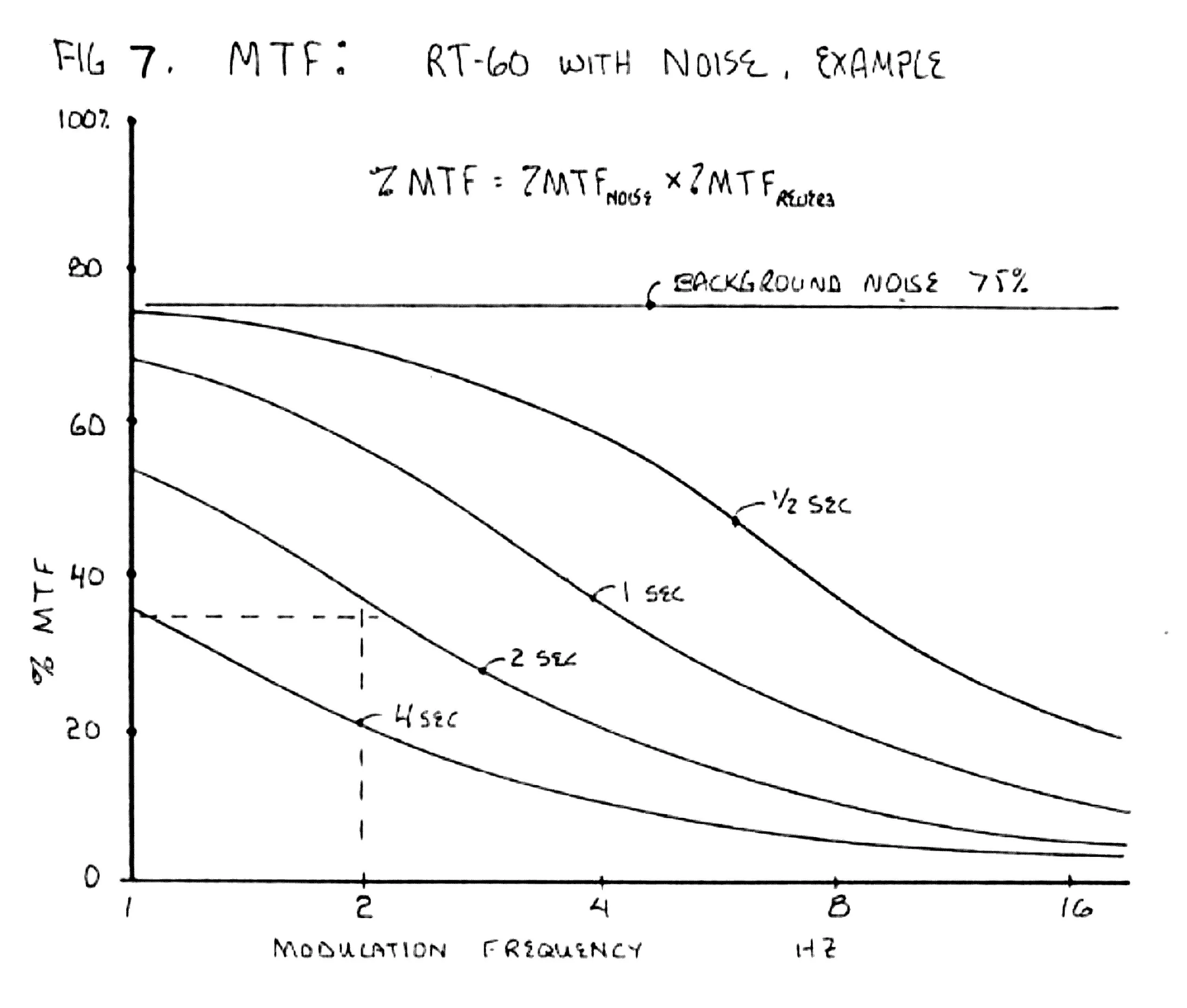
The response curve that forms the basis of articulation measurements is called the MTF, or Modulation Transfer Function, ranges from zero to 100%. Zero percent MTF signifies that a modulated signal is undetectable by a person. Tone bursts, as in a Morse code transmission, would have absolutely no signal modulation at the receiving end. There are two ways this can happen.
To achieve zero signal modulation, the receiver could be a long way from the transmitter. It would receive nothing but background noise, “static” on the transmission channel. The tone sequence may well actually be received but it is not perceived by the listener if the signal is buried more than 10 dB below the background noise floor. The MTF is zero if the external noise is too loud compared to the modulated signal.
Another instance in which MTF drops to zero would occur when transmitting code across a reverb chamber. With a typical RT-60 of 10 seconds (sound level drops 60 dB in 10 seconds), the rapid staccato of a Morse code will be totally obscured by the room’s reverberant noise field. Because the tone of the reverberation sounds just like the signal, it masks the signal very easily. The reverberant field type of noise easily masks signal modulation that is 5 dB below the noise floor.
The preferred signal perception is 100% MTF. Morse Code could easily have 40 dB of electronic signal modulation, the tone burst signal level relative to the circuit noise floor. People have limits to perceived modulation. Sound over 140 dB is painful and that under 10 dB is inaudible. Maximum perceptible modulation is 130 dB. That is why a 1000 dB signal-to-noise ratio is imperceptibly different from a 100dB SNR, assuming the signal strength for both signals was the same.
We might be able to tolerate 130 dB of signal level modulation but 20 dB has proven to be effectively full range. A 10 dB modulated SNR has proven clearly heard, this would occur if a 70 dB test tone was placed in a 60 dB background noise level. The result of many studies in perception is that for effective communication, modulated 18 dB SNR is sufficient to be called 100% modulation. At the other end is ½ dB modulation which is essentially imperceptible. The dynamic range for modulated signals that is significant to human perception is about 18 dB. With these two end points defined, all that remains is to fill in between the intervening points. Much research into human perception has been spent in developing this relationship shown in Figure 1.